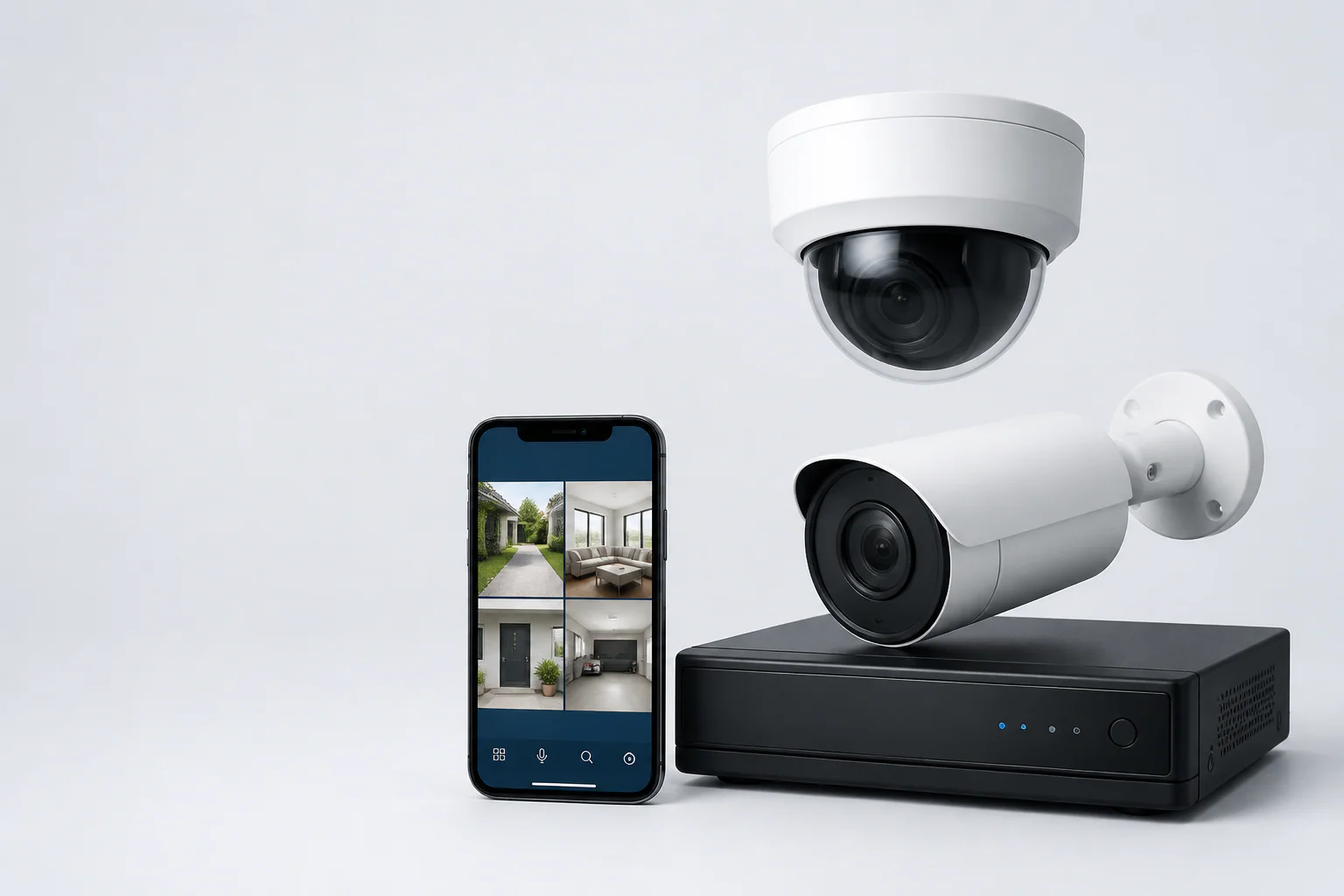
An NVR records network/IP cameras; a DVR records compatible analog-over-coax cameras. Choose after confirming camera signal and cable infrastructure. Channel count alone is not enough—check resolution, bandwidth, PoE capacity, analytics and storage bays.
Recorder type follows the camera architecture
An NVR receives video over IP. A DVR digitizes compatible signals over coax. Hybrid products may accept multiple formats, but exact channel and feature compatibility must be verified.
Specifications buyers commonly miss
An “8-channel” label states connection count, not quality per channel. Check NVR bandwidth, resolution, frame rate, PoE budget, decoding, storage bays and analytics.
Storage is an engineering calculation
Retention depends on camera count, resolution, frame rate, codec, scene activity, bitrate and schedule. Include practical overhead and applicable requirements.
- Document estimate settings
- Confirm usable capacity
- Check disk health monitoring
- Test search, export and playback
Upgrade paths
If coax is serviceable, a compatible DVR/XVR may minimize disruption. For new cabling or expansion, an NVR and structured PoE design can be more flexible.
| Factor | NVR | DVR |
|---|---|---|
| Camera | IP/network | Compatible analog |
| Cable | CAT6 | Coax plus power |
| Capacity | Bandwidth and PoE | Format support |
| Expansion | Network topology | Home-run routes |
Frequently asked questions
Can an NVR record WiFi cameras?
Only if protocols are compatible and the network is reliable.
Can an NVR use old coax?
Not directly in a standard design. Adapters add complexity.
How much storage is needed?
Calculate from recording settings and retention, not channel count.